
UNESCO World Heritage Sites in Mongolia
Mongolia has 4 sites on the UNESCO World Heritage List (4 cultural), the first inscribed in 2004 (Orkhon Valley). The map below plots every one of them alongside the rest of the List, and each site is written up in full further down the page.
- World Heritage Sites
- 4
- Cultural
- 4
- Natural and Mixed
- 0
- First Inscribed
- 2004
Map of World Heritage Sites in Mongolia
CulturalNaturalMixedIn DangerLarge dots are in Mongolia. Click a dot to read about the site.

Orkhon Valley
Mongolia · 47.5567° N, 102.8314° E · 1,220 km² · 145 km from Arvayheer
The Orkhon Valley Cultural Landscape sprawls along the banks of the Orkhon River in Central Mongolia, some 320 km west from the capital Ulaanbaatar. It was inscribed by UNESCO in the World Heritage List as representing the development of nomadic pastoral traditions spanning more than two millennia.
Adapted from Wikipedia: Orkhon Valley (CC BY-SA 4.0).
Why Orkhon Valley Is Listed
- (ii)
- An important interchange of human values.
- (iii)
- A unique testimony to a cultural tradition or civilisation.
- (iv)
- An outstanding example of a type of building or landscape.
More about Orkhon Valley
UNESCO's Description
The 121,967-ha Orkhon Valley Cultural Landscape encompasses an extensive area of pastureland on both banks of the Orkhon River and includes numerous archaeological remains dating back to the 6th century. The site also includes Kharkhorum, the 13th- and 14th-century capital of Chingis (Genghis) Khan’s vast Empire. Collectively the remains in the site reflect the symbiotic links between nomadic, pastoral societies and their administrative and religious centres, and the importance of the Orkhon valley in the history of central Asia. The grassland is still grazed by Mongolian nomadic pastoralists.
From the UNESCO World Heritage Centre (CC BY-SA IGO 3.0).

Petroglyphic Complexes of the Mongolian Altai
Mongolia · 49.3339° N, 88.3953° E · 113 km² · 122 km from Olgiy
The numerous rock carvings and funerary monuments found in these three sites illustrate the development of culture in Mongolia over a period of 12,000 years. The earliest images reflect a time (11,000 - 6,000 BC) when the area was partly forested and the valley provided a habitat for hunters of large game. Later images show the transition to herding as the dominant way of life. The most recent images show the transition to a horse-dependent nomadic lifestyle during the early 1st millennium BC, the Scythian period and the later Turkic period (7th and 8th centuries AD). The carvings contribute valuably to our understanding of pre-historic communities in northern Asia.
Description from the UNESCO World Heritage Centre (CC BY-SA IGO 3.0).
Why Petroglyphic Complexes of the Mongolian Altai Is Listed
- (iii)
- A unique testimony to a cultural tradition or civilisation.
Burkhan Khaldun
Mongolia · 48.7833° N, 109.1667° E · 4,437 km²
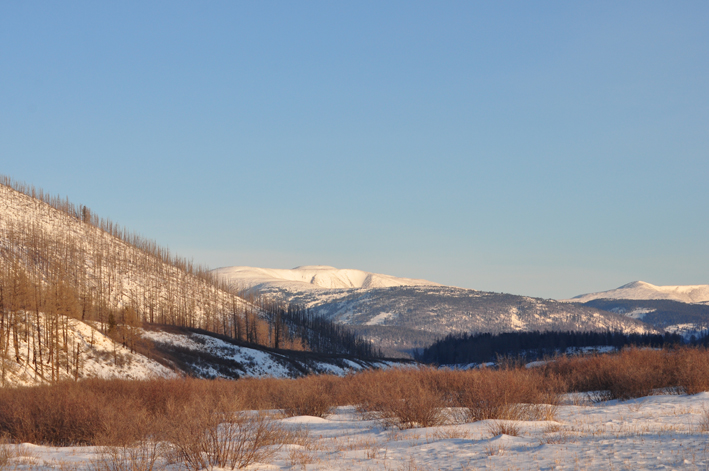
The Burkhan Khaldun (Mongolian: Бурхан Халдун [pʊ́rχaɴ‿χáɬtʊɴ]) is one of the Khentii Mountains in the Khentii Province of northeastern Mongolia. The mountain or its locality is believed to be the birthplace of Genghis Khan as well as his tomb. It is also the birthplace of one of his most successful generals, Subutai.
The mountain is part of the 12,000 square kilometres (4,600 sq mi) Khan Khentii Strictly Protected Area established in 1992. It had strong religious significance before Genghis Khan made it a powerful landmark and is considered the most sacred mountain in Mongolia since it was designated as sacred by Genghis Khan. It was inscribed as a UNESCO World Heritage Site on 4 July 2015 under the title "Great Burkhan Khaldun Mountain and its surrounding sacred landscape." Under a Presidential Decree of 1995 the worship of this mountain has been formalised and the mountain declared a national monument. Its ecosystem is complex with unique biodiversity with flora of the Central Asian steppe. It has 50 species of fauna and 253 species of birds.
Adapted from Wikipedia: Burkhan Khaldun (CC BY-SA 4.0).
Why Burkhan Khaldun Is Listed
- (iv)
- An outstanding example of a type of building or landscape.
- (vi)
- A direct association with events, ideas or beliefs of universal significance.
More about Burkhan Khaldun
UNESCO's Description
The site is situated in the north-east of the country in the central part of the Khentii mountain chain where the vast Central Asian steppe meets the coniferous forests of the Siberian taiga. Burkhan Khaldun is associated with the worship of sacred mountains, rivers and ovoo-s (shamanic rock cairns), in which ceremonies have been shaped by a fusion of ancient shamanic and Buddhist practices. The site is also believed to be the place of Genghis Khan’s birth and burial. It testifies to his efforts to establish mountain worship as an important part of the unification of the Mongol people.
From the UNESCO World Heritage Centre (CC BY-SA IGO 3.0).
Geography
Burkhan Khaldun is in the northeast of Mongolia in the middle of the Khentii mountain range. The mountain is integral to the Khan Khentii Strictly Protected Area established in 1992, which extends over an area of 12,000 square kilometres (4,600 sq mi).
Burkhan Khaldun means the "God Mountain" or "Buddha Mountain" and is also called Khentii Khan (The King of the Khentii Mountain range). It is one of the Khentii Mountains in the Khentii Province of northeastern Mongolia. It is the highest mountain of the region, rising to an elevation of 2,362 metres (7,749 ft), and is crescent-shaped.
History
In the Secret History of the Mongols, Genghis Khan, who later became the "World Conqueror" believing in his own destiny, said: I went up Mount Burkhan, Though I was frightened and ran like an insect, I was shielded by Mount Burkhan Khaldun, I will honor Burkhan Khaldun with sacrifices every morning and pray to it every day: my children and my children’s children shall be mindful of this...
to them (SHM §1)”...When Toguril Khan set out, as he was approaching in the direction of the Burgi Escarpment of the Kerulen River on the Southern side of Burkahn Khaldun (SHM §107).
A Presidential Decree of 1995 formalized the worship of the Burkhan Khaldun Mountain as a national monument.
Sections adapted from Wikipedia: Burkhan Khaldun (CC BY-SA 4.0).
Deer Stone Monuments, the Heart of Bronze Age Culture
Mongolia · 47.7428° N, 101.2258° E · 98 km²
Located on the slopes of the Khangai Ridge in central Mongolia, these deer stones were used for ceremonial and funerary practices. Dating from about 1200 to 600 BCE, they stand up to four metres tall and are set directly in the ground as single standing stones or in groups, and are almost always located in complexes that include large burial mounds called khirgisüürs and sacrificial altars. Covered with highly stylized or representational engravings of stags, deer stones are the most important surviving structures belonging to the culture of Eurasian Bronze Age nomads that evolved and then slowly disappeared between the 2nd and 1st millennia BCE.
Description from the UNESCO World Heritage Centre (CC BY-SA IGO 3.0).
Why Deer Stone Monuments, the Heart of Bronze Age Culture Is Listed
- (i)
- A masterpiece of human creative genius.
- (iii)
- A unique testimony to a cultural tradition or civilisation.
World Heritage in Mongolia: Quick Answers
- How many UNESCO World Heritage Sites are in Mongolia?
- Mongolia has 4 World Heritage Sites: 4 cultural.
- What was the first World Heritage Site in Mongolia?
- Orkhon Valley, inscribed in 2004. The most recent is Deer Stone Monuments, the Heart of Bronze Age Culture, inscribed in 2023.
- Are any World Heritage Sites in Mongolia in danger?
- None of the World Heritage Sites in Mongolia is on UNESCO's List of World Heritage in Danger.