
Joshua Slocum’s Solo Voyage on the Spray (1895–1898)
In 1895 the Nova Scotia-born sea captain Joshua Slocum set out from Boston alone in the Spray, an old oyster sloop he had rebuilt himself. Over three years and 74,000 km he crossed the Atlantic twice, fought through the Strait of Magellan, and sailed across the Pacific and Indian Oceans, becoming the first person to sail around the world alone. His book Sailing Alone Around the World is still in print.
66,190 km mapped20 stops1,160 days (about 3 years)
Route Map of Slocum’s voyage
- Route from recorded positions
- 1Numbered stop (see the itinerary)
- Ship on the map: full-rigged three-masted ship (18th and 19th centuries)
Lines are drawn by YearMaps between the recorded stops, kept at sea around Natural Earth coastlines. They show the order and general track of the voyage, not the exact course steered. How the maps are made.
About Slocum’s voyage
Joshua Slocum (February 20, 1844 – on or shortly after November 14, 1909) was the first person to sail single-handedly around the world. He was a Nova Scotian-born, naturalised American seaman and adventurer, and a noted writer. In 1900 he wrote a book about his journey, Sailing Alone Around the World, which became an international best-seller. He disappeared in November 1909 while aboard his boat, the Spray.
From Wikipedia: Joshua Slocum (CC BY-SA 4.0).
Itinerary: 20 Stops
In order of the voyage. Numbers match the map; select a stop to show it there.
Boston
DepartureSlocum sails from Boston alone.
Yarmouth, Nova Scotia
Port of callA visit to his childhood home coast.
Horta, Azores
Port of callPlums and white cheese leave him delirious; he dreams the pilot of the Pinta is steering.
Gibraltar
Port of callWarned of pirates in the Red Sea, Slocum decides to go west about instead.
Pernambuco (Recife)
Port of callSlocum recrosses the Atlantic, chased by a pirate felucca off Morocco.
Montevideo
Port of callThe Spray runs aground on the coast of Uruguay and is refitted.
Punta Arenas
Port of callSlocum enters the Strait of Magellan. He scatters tacks on deck to deter night raiders.
Cape Pillar (exit of the strait)
PassageAfter being blown back south and through the Cockburn Channel, Slocum reaches the Pacific at last.
Juan Fernández Islands
Port of callRobinson Crusoe’s island.
Apia, Samoa
Port of callAfter 72 days at sea. Slocum visits Robert Louis Stevenson’s widow.
Sydney
Port of callA long stay in Australia, lecturing to pay his way.
Melbourne
Port of callSlocum charges visitors to see a shark he has caught.
Thursday Island, Torres Strait
Port of callSlocum takes the inner route up the Great Barrier Reef.
Cocos (Keeling) Islands
Port of callA passage of 23 days in which he steers for about three hours in all.
Port Louis, Mauritius
Port of callSlocum stays seven weeks.
Durban
Port of callPresident Kruger insists to Slocum that the world is flat.
Cape Town
Port of callThree months ashore before the last ocean.
St. Helena
Port of callSlocum is given a goat that eats his chart of the West Indies.
Grenada
Port of callThe US is now at war with Spain; Slocum sights the battleship Oregon.
Newport, Rhode Island
ArrivalAfter three years and 74,000 km Slocum comes home; he reaches Fairhaven on 3 July.
Sources: Slocum’s Sailing Alone Around the World (1900, public domain), via Wikipedia: Joshua Slocum.
Joshua Slocum’s Solo Voyage on the Spray in Depth
The Spray: First solo circumnavigation of the earth
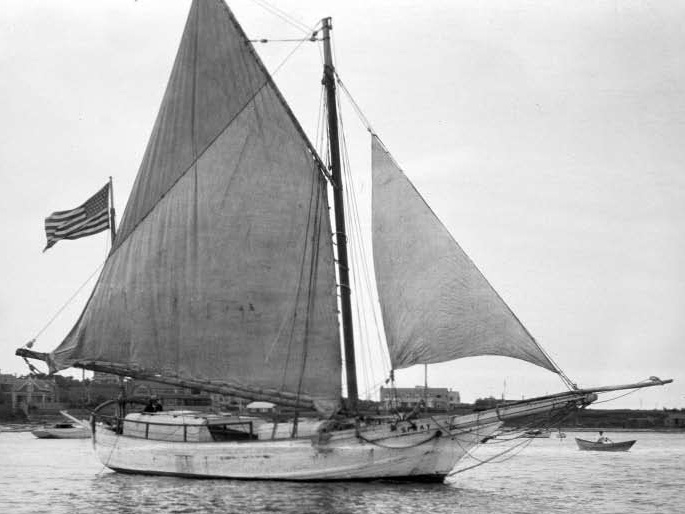
Slocum rebuilt the 36 ft 9 in (11.2 m) gaff rigged sloop oyster boat named Spray in Fairhaven, Massachusetts, during 1891 and 1892. On June 21, 1892, he launched the painstakingly rebuilt vessel.
I had resolved on a voyage around the world, and as the wind on the morning of April 24, 1895 was fair, at noon I weighed anchor, set sail, and filled away from Boston, where the Spray had been moored snugly all winter. The twelve o'clock whistles were blowing just as the sloop shot ahead under full sail. A short board was made up the harbor on the port tack, then coming about she stood to seaward, with her boom well off to port, and swung past the ferries with lively heels. A photographer on the outer pier of East Boston got a picture of her as she swept by, her flag at the peak throwing her folds clear. A thrilling pulse beat high in me. My step was light on deck in the crisp air. I felt there could be no turning back, and that I was engaging in an adventure the meaning of which I thoroughly understood.
After an extended visit to his boyhood home at Brier Island and visiting old haunts on the coast of Nova Scotia, Slocum departed North America at Sambro Island Lighthouse near Halifax, Nova Scotia, on July 3, 1895.
Slocum intended sailing eastward around the world, using the Suez Canal, but when he got near Gibraltar he realized that sailing through the southern Mediterranean would be too dangerous for a lone sailor because piracy was still prevalent there at the time. So he decided to sail westward, in the southern hemisphere. He headed to Brazil, and then to the Straits of Magellan. At that point he was unable to start across the Pacific for forty days because of a storm. Eventually, he made his way to Australia, sailed north along its east coast, crossed the Indian Ocean, rounded the Cape of Good Hope, and then headed back to North America.
Slocum navigated without a chronometer, instead relying on the traditional method of dead reckoning to establish longitude, which required only a cheap tin clock for approximate time, and used noon-sun sights for latitude. On one long passage in the Pacific, he also famously shot a lunar distance observation, decades after those observations had ceased to be commonly employed, which allowed him to check his longitude independently. However, Slocum's primary method for finding longitude was still dead reckoning, and he recorded only one lunar observation during the entire circumnavigation.
Slocum normally sailed the Spray without touching the helm. Due to the length of the sail plan relative to the hull, and the long keel, the Spray was capable of self-steering (unlike faster modern craft), and he balanced it stably on any course relative to the wind by adjusting or reefing the sails and by lashing the helm fast. He sailed 2,000 miles (3,200 km) west across the Indian Ocean without once touching the helm.
More than three years later, on June 27, 1898, he returned to Newport, Rhode Island, having circumnavigated the world and sailing a distance of more than 46,000 miles (74,000 km). Slocum's return went almost unnoticed. The Spanish–American War, which had begun two months earlier, dominated the headlines but, after the end of major hostilities, many American newspapers published articles describing Slocum's adventure.
In 1899, he published his account of the voyage in Sailing Alone Around the World, first serialized in The Century Magazine and then in several book-length editions. Reviewers received the slightly anachronistic age-of-sail adventure story enthusiastically. Arthur Ransome went so far as to declare: "Boys who do not like this book ought to be drowned at once." In his review, Sir Edwin Arnold wrote, "I do not hesitate to call it the most extraordinary book ever published."
Slocum's book deal was an integral part of his journey.
Sections adapted from Wikipedia: Joshua Slocum (CC BY-SA 4.0).
Pictures of Slocum’s voyage
12 images from Wikimedia Commons. Select one to enlarge it.
Book cover of Sailing Alone Around the World by Joshua SlocumUser:Stbalbach · Public domain · Commons The sloop Spray being hauled up the Erie Canal to the Pan-American Exposition in Buffalo in 1901.Carlstaffanholmer · CC BY-SA 4.0 · Commons The U.S. Naval Observatory copy of the first edition Bowditch has the imprint Printed at Newburyport, MassachusettsCreator:Nathaniel Bowditch · Public domain · Commons Chart of the Spray's Atlantic voyages from Boston to Gibraltar, thence to the Strait of Magellan, in 1895, and finally homeward bound from the Cape of Good Hope in 1898.Thomas Fogarty (1873 - 1938) & George Varian (1865-1923) · Public domain · Commons Body-plan of the Spray.Thomas Fogarty (1873 - 1938) & George Varian (1865-1923) · Public domain · Commons Deck-plan of the Spray.Thomas Fogarty (1873 - 1938) & George Varian (1865-1923) · Public domain · Commons The Spray's course from Australia to South Africa.Thomas Fogarty (1873 - 1938) & George Varian (1865-1923) · Public domain · Commons Lines of the Spray.Thomas Fogarty (1873 - 1938) & George Varian (1865-1923) · Public domain · Commons The Spray's course from the Strait of Magellan to Torres Strait.Thomas Fogarty (1873 - 1938) & George Varian (1865-1923) · Public domain · Commons Spray sail planThomas Fogarty (1873 - 1938) & George Varian (1865-1923) · Public domain · Commons The course of the Spray through the Strait of Magellan.Thomas Fogarty (1873 - 1938) & George Varian (1865-1923) · Public domain · Commons Chart of the Spray's course around the world—April 24, 1895, to July 3, 1898.Thomas Fogarty (1873 - 1938) & George Varian (1865-1923) · Public domain · Commons
Frequently Asked Questions
How long did Slocum’s voyage take?
It lasted 1,160 days (about 3 years), from 24 April 1895 to 27 June 1898.
How far did Slocum’s voyage travel?
The route as mapped here, through all 20 stops, is about 66,190 km (35,740 nautical miles). It follows the recorded stops at sea and is a reconstruction, so the true distance sailed was longer.
Who led Slocum’s voyage?
Joshua Slocum, sponsored by None (Slocum’s own voyage).
What ship was used on Slocum’s voyage?
Spray.
Where did Slocum’s voyage start and end?
It started at Boston (24 April 1895) and ended at Newport, Rhode Island (27 June 1898).
What did Slocum’s voyage achieve?
First solo circumnavigation of the world.