Gobi Desert
Desert · 1.09M km²
Gobi Desert is a desert in Asia, covering an estimated 1.09M km². It extends across China and Mongolia. It is the 2nd-largest of the 58 deserts with a mapped extent in YearMaps.
The Gobi Desert is a large, cold desert and grassland region in southern Mongolia and North China. It is the sixth-largest desert in the world.
The name of the desert comes from the Mongolian word Gov' (Говь, 'dryland'), used to refer to all of the waterless regions in the Mongolian Plateau; the borrowed Chinese term gēbì (戈壁) is used to refer to rocky, semi-deserts such as the Gobi itself rather than sandy deserts.
Adapted from Wikipedia: Gobi Desert (CC BY-SA 4.0).
- Feature class
- Desert
- Mapped extent
- 1.09M km²
- Size rank
- #2 of 58 deserts
- Region
- Asia
- Countries
- China, Mongolia
- Coordinates
- 41.7290°, 102.2823°
- Summits:
- Tergun Bogd (3,957 m), Otgon Tenger (4,000 m), Gora Munku-Sardyk (3,491 m)
- Ranges:
- Yin Mountains (Asia), Taihang Mountains (Asia)
- Settlements:
- Arvayheer (372 km), Ulaanbaatar (391 km), Bayankhongor (497 km)
More about Gobi Desert
Geography
The Gobi measures 1,600 km (1,000 mi) from southwest to northeast and 800 km (500 mi) from north to south. The desert is widest in the west, along the line joining the Lake Bosten and the Lop Nor (87°–89° east). Its area is approximately 1,295,000 square kilometres (500,000 sq mi).
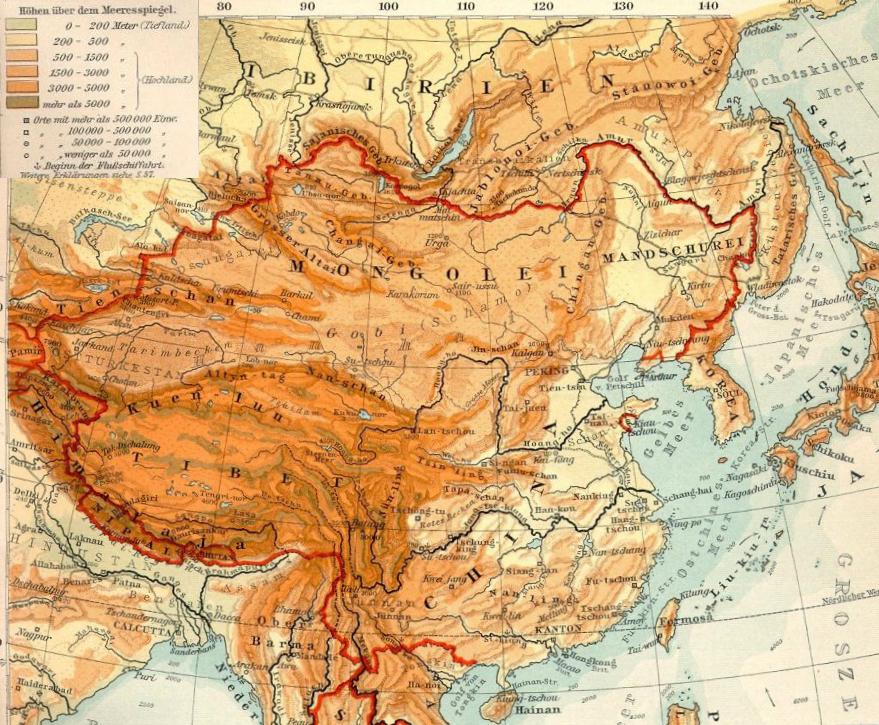
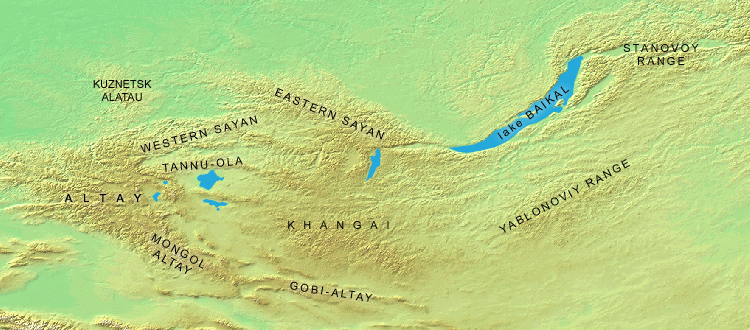
Gobi includes the long stretch of desert extending from the foot of the Pamirs (77° east) to the Greater Khingan Mountains, 116–118° east, on the border of Manchuria; and from the foothills of the Altay, Sayan, and Yablonoi mountain ranges on the north to the Kunlun, Altyn-Tagh, and Qilian mountain ranges, which form the northern edges of the Tibetan Plateau, on the south.
Climate
The Gobi is overall a cold desert, with frost and occasionally snow occurring on its dunes. Besides being quite far north, it is also located on a plateau roughly 910–1,520 m (2,990–4,990 ft) above sea level, which contributes to its low temperatures. An average of about 194 mm (7.6 in) of rain falls annually in the Gobi. Additional moisture reaches parts of the Gobi in winter as snow is blown by the wind from the Siberian Steppes. These winds may cause the Gobi to reach −40 °C (−40 °F) in winter to 45 °C (113 °F) in summer.
However, the climate of the Gobi is one of great extremes, with rapid changes of temperature of as much as 35 °C (63 °F) in 24-hour spans.
In southern Mongolia, the temperature has been recorded as low as −32.8 °C (−27.0 °F).
Conservation, ecology, and economy
The Gobi Desert is the source of many important fossil finds, including the first dinosaur eggs, twenty-six of which, averaging 23 centimetres (9 in) in length, were uncovered in 1923.
Archeologists and paleontologists have done excavations in the Nemegt Basin in the northwestern part of the Gobi Desert (in Mongolia), which is noted for its fossil treasures, including early mammals, dinosaur eggs, and prehistoric stone implements, some 100,000 years old.
Despite the harsh conditions, these deserts and the surrounding regions sustain many animal species. Some are even unique, including black-tailed gazelles, marbled polecats, wild Bactrian camels, Mongolian wild ass and sandplovers. They are occasionally visited by snow leopards, Gobi bears, and wolves.
History
There is little information about early habitation of the Gobi desert.
Lisa Janz has proposed a system of nomenclature for early Gobi desert habitation. They are Oasis I, Oasis II, Oasis III.
honeycomb imprinted, corded, string paddled, low and high fired pottery with a sand and gravel mixture.
Starting around 8000 cal BP there was a warm wet phase in the Gobi desert.By 7500 cal BP lake levels in the Western Gobi reached their peak. Around this time there was meadow steppe vegetation around lakes. In Ulaan Nuur there may have been shrubby riparian woodlands.
Sections adapted from Wikipedia: Gobi Desert (CC BY-SA 4.0).
Gobi Desert: Key Facts
| Area | 2,354,460 km² |
|---|---|
| Highest point | Bogd Khan Mountain |
Facts from Wikidata Q42070 (CC0).