
Second Voyage of Christopher Columbus (1493–1496)
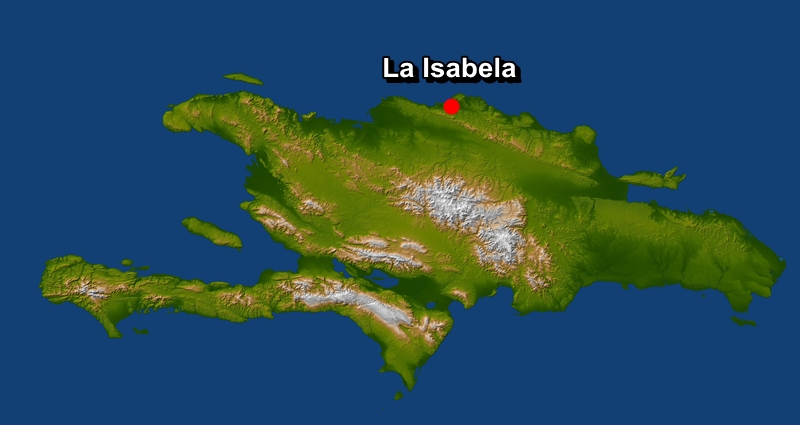
Columbus returned to the Caribbean in 1493 with seventeen ships and about 1,200 settlers to found a colony. He sighted Dominica, Guadeloupe and Puerto Rico, found the La Navidad garrison dead, and founded La Isabela on Hispaniola before exploring Jamaica and the south coast of Cuba, which he insisted was part of Asia.
17,316 km mapped13 stops990 days (about 2.5 years)
Route Map of Columbus’s second voyage
- Route from recorded positions
- 1Numbered stop (see the itinerary)
- Ship on the map: carrack with castles fore and aft (Age of Discovery), sailing as a fleet of 17, four drawn
Lines are drawn by YearMaps between the recorded stops, kept at sea around Natural Earth coastlines. They show the order and general track of the voyage, not the exact course steered. How the maps are made.
Itinerary: 13 Stops
In order of the voyage. Numbers match the map; select a stop to show it there.
Cádiz
DepartureA fleet of seventeen ships leaves Cádiz.
San Sebastián de La Gomera
Port of callLast stop in the Canaries.
Dominica
LandfallA faster, more southerly crossing of 21 days. Columbus names the island for the Sunday it was sighted.
Guadeloupe
LandfallThe Spaniards land and find signs of Kalinago (Carib) settlements.
Saint Croix (Ayay)
EventA fight at Salt River with Kalinago in a canoe, the first recorded battle between Europeans and Native Americans.
Puerto Rico (San Juan Bautista)
LandfallColumbus lands on the west coast of Puerto Rico.
La Navidad
EventThe fort is burned and every man of the garrison is dead.
La Isabela
Port of callColumbus founds La Isabela, the first planned European town in the Americas. Most of the fleet sails home; Columbus explores on with three caravels.
St. Ann’s Bay, Jamaica
LandfallColumbus reaches Jamaica, which he names Santiago.
Isla Evangelista (Isle of Youth)
PassageColumbus makes his crews swear that Cuba is a mainland and turns back.
La Isabela
Port of callColumbus returns ill to a colony in turmoil.
Guadeloupe
Port of callColumbus sails for Spain in March 1496 and stops to provision.
Cádiz
ArrivalThe two caravels reach Cádiz with hungry crews and Taíno captives.
Sources: Wikipedia: Voyages of Christopher Columbus.
Second Voyage of Christopher Columbus in Depth
Second voyage (1493–1496)
The stated purpose of the second voyage was to convert the Indigenous Americans to Christianity. Before Columbus left Spain, he was directed by Ferdinand and Isabella to maintain friendly, even loving, relations with the Natives. He set sail from Cádiz, Spain, on 25 September 1493.
The fleet for the second voyage was much larger: two carracks (naos) and 15 caravels. The two carracks were the flagship Marigalante ("Gallant Mary") and the Gallega; the caravels were the Fraila ("the nun"), San Juan, Colina ("the hill"), Gallarda ("the gallant"), Gutierre, Bonial, Rodriga, Triana, Vieja ("the old"), Prieta ("the brown"), Gorda ("the fat"), Cardera, and Quintera. The Niña returned for this expedition, which also included a ship named Pinta which was probably identical to that from the first expedition. In addition, the expedition saw the construction of the first ship in the Americas, the Santa Cruz or India.
Lesser Antilles and Puerto Rico
On 3 November 1493, Christopher Columbus landed on a rugged shore on an island that he named Dominica. On the same day, he landed at Marie-Galante, which he named Santa María la Galante. After sailing past Les Saintes (Todos los Santos), he arrived at Guadeloupe (Santa María de Guadalupe), which he explored between 4 November and 10 November 1493. The exact course of his voyage through the Lesser Antilles is debated, but it seems likely that he turned north, sighting and naming many islands including Santa María de Montserrat (Montserrat), Santa María la Antigua (Antigua), Santa María la Redonda (Redonda), and Santa Cruz (Saint Croix, on 14 November). He also sighted and named the island chain of Santa Úrsula y las Once Mil Vírgenes (the Virgin Islands), and named the island of Virgin Gorda.
On Santa Cruz, the Europeans saw a canoe with a few Carib men and two women. They had two male captives, and had recently castrated them. The Europeans pursued them, and were met with arrows from both the men and women, fatally wounding at least one man, who perished about a week later. The Europeans either killed or captured all aboard the canoe, thereafter beheading them. Another was thrown overboard, and when he was spotted crawling away holding his entrails, the Arawaks recommended he be recaptured so he would not alert his tribe; he was thrown overboard again, and then had to be shot down with arrows.
Hispaniola and Jamaica
On 22 November, Columbus sailed from San Juan Bautista (present-day Puerto Rico) to Hispaniola. The next morning, a native taken during the first voyage was returned to Samaná Bay. The fleet sailed about 170 miles (270 km) over two days and discovered, at Monte Cristi, decomposing bodies of four men; one had a beard implying he had been a Spaniard. On the night of 27 November, cannons and flares were ignited in an attempt to signal La Navidad, but there was no response. A canoe party led by a cousin of Guacanagari presented Columbus with two golden masks and told him that Guacanagari had been injured by another chief, Caonabo, and that except for some Spanish casualties resulting from sickness and quarrel, the rest of his men were well. The next day, the Spanish fleet discovered the burnt remains of the Navidad fortress, and Guacanagari's cousin admitted that the Europeans had been wiped out by Caonabo. Other Natives showed the Spaniards some of the bodies, and said that they had "taken three or four women apiece". While some suspicion was placed on Guacanagari, it gradually emerged that two of the Spaniards had formed a murderous gang in search of gold and women, prompting Caonabo's wrath. The fleet then fought the winds, traveling only 32 miles (51 km) over 25 days, and arriving at a plain on the north coast of Hispaniola on 2 January 1494. There, they established the settlement of La Isabela. Columbus spent some time exploring the interior of the island for gold.
Slavery, settlers, and tribute
Columbus had planned for Queen Isabella to set up trading posts with the cities of the Far East made famous by Marco Polo, but whose Silk Road and eastern maritime routes had been blockaded to her crown's trade. However, Columbus would never find Cathay (China) or Zipangu (Japan), and there was no longer any Great Khan for trade treaties.
In 1494, Columbus sent Alonso de Ojeda (whom a contemporary described as "always the first to draw blood wherever there was a war or quarrel") to Cibao (where gold was being mined), which resulted in Ojeda's capturing several Natives on an accusation of theft. Columbus had the native chief set free. Ojeda cut the ears off of one Native, and sent the others to La Isabela in chains, where Columbus ordered them to be decapitated. During his brief reign, Columbus executed Spanish colonists for minor crimes, and used dismemberment as another form of punishment. By the end of 1494, disease and famine had claimed two-thirds of the Spanish settlers. A native Nahuatl account depicts the social breakdown that accompanied the pandemic: "A great many died from this plague, and many others died of hunger. They could not get up to search for food, and everyone else was too sick to care for them, so they starved to death in their beds."
By 1494, Columbus had shared his viceroyship with one of his military officers named Margarit, ordering him to prioritize Christianizing the Natives.
Sections adapted from Wikipedia: Voyages of Christopher Columbus (CC BY-SA 4.0).
Pictures of Columbus’s second voyage
23 images from Wikimedia Commons. Select one to enlarge it.
Templo de las Américas construido en 1994 cerca del Parque Arqueológico de La Isabela, Luperón, República DominicanaMariordo (Mario Roberto Durán Ortiz) · CC BY-SA 4.0 · Commons Description plate of the Historical and Archaeological National Park of La Isabela, Luperón, Dominican RepublicMariordo (Mario Roberto Durán Ortiz) · CC BY-SA 4.0 · Commons La Isabela Historical and Archaeological National Park, Luperón, Dominican RepublicMariordo (Mario Roberto Durán Ortiz) · CC BY-SA 4.0 · Commons Portrait of a Man, Said to be Christopher Columbus dead title QS:P1476,en:"Portrait of a Man, Said to be Christopher Columbus dead "label QS:Len,"Portrait of a Man, Said to be Christopher Columbus dead "label…Sebastiano del Piombo · Public domain · Commons Restos de la fundación de la Casa de Colón en el Parque Nacional Histórico y Arqueológico de La IsabelaMariordo (Mario Roberto Durán Ortiz) · CC BY-SA 4.0 · Commons Colonial cemetery in the Historical and Archaeological National Park of La IsabelaMariordo (Mario Roberto Durán Ortiz) · CC BY-SA 4.0 · Commons Skeleton of a Spanish settler buried in the cemetery of La Isabela, Historical and Archaeological National Park of La Isabela, Luperón, Dominican Republic.Mariordo (Mario Roberto Durán Ortiz) · CC BY-SA 4.0 · Commons Maqueta de la Casa Colón, Museo Parque Nacional Histórico y Arqueológico de La IsabelaMariordo (Mario Roberto Durán Ortiz) · CC BY-SA 4.0 · Commons Panoramic view of the Historical and Archaeological National Park of La Isabela, Luperón, Dominican RepublicMariordo (Mario Roberto Durán Ortiz) · CC BY-SA 4.0 · Commons Panoramic view of the cove of the Historical and Archaeological National Park of La Isabela, Luperón, Dominican RepublicMariordo (Mario Roberto Durán Ortiz) · CC BY-SA 4.0 · Commons Replicas of the Caravels Pinta, Niña and the carrack Santa Maria. Lying in the North River, New York. The two caravels and the carrack which crossed from Spain to be present at the World's Fair at Chicago.E. Benjamin Andrews · Public domain · Commons The map of the Atlantic Ocean according to Paolo dal Pozzo Toscanelli in 1474, overlaid on top of a current map.John George Bartholomew · Public domain · Commons casa di Cristoforo ColomboEttorre (gregorio) mail: ettorre@gmail.com · CC BY-SA 4.0 · Commons Genova, Castello d'Albertis, Museo delle Culture del Mondo - Loggia, statua del "Colombo giovinetto", di Giulio Monteverde.Twice25 e Rinina25 · CC BY 2.5 · Commons Christopher Columbus, head-and-shoulders portrait, facing slightly right.Unknown authorUnknown author · Public domain · Commons Christopher Columbus FaceAlejo Fernández (1475-1545) · Public domain · Commons Christopher Columbus at the gates of the monastery of Santa Maria de la Rabida with his son Diego. Painting by Benito Mercade y Fabregas.Benet Mercadé · Public domain · Commons Christopher Colombus map. Lisbon, workshop of Bartolomeo and Christopher Colombus, c.1490. This map cannot be definitely linked to Columbus.[1]Bartolomeo and Christopher Colombus · Public domain · Commons Colombus Notes on Marco Polo's "Le Livre des Merveilles", latin editionMarco Polo with handwritten notes and sketches by Christopher Columbus · Public domain · Commons Monument of Columbus in Buenos AiresGeorgez · Public domain · Commons Columbus_1892_Issue-$5.jpgUS Post Office · Public domain · Commons More parade shots.Jazz Guy from New Jersey, United States · CC BY 2.0 · Commons Columbus Monument, Columbus Circle, Manhattan, New York City, New York, USA.Daderot · CC0 · Commons
Frequently Asked Questions
How long did Columbus’s second voyage take?
It lasted 990 days (about 2.5 years), from 25 September 1493 to 11 June 1496.
How far did Columbus’s second voyage travel?
The route as mapped here, through all 13 stops, is about 17,316 km (9,350 nautical miles). It follows the recorded stops at sea and is a reconstruction, so the true distance sailed was longer.
Who led Columbus’s second voyage?
Christopher Columbus, sponsored by Crown of Castile.
What ship was used on Columbus’s second voyage?
17 ships, flagship Marigalante.
Where did Columbus’s second voyage start and end?
It started at Cádiz (25 September 1493) and ended at Cádiz (11 June 1496).
What did Columbus’s second voyage achieve?
La Navidad found destroyed; La Isabela founded as the first planned Spanish town; Jamaica and the south coast of Cuba explored.