
Paleozoic Era · Carboniferous Period
Earth 350 Million Years Ago: The Early Carboniferous
Earth 350 million years ago: four-legged animals on land, the first forests spreading and Gondwana closing in on Laurussia to build Pangea.
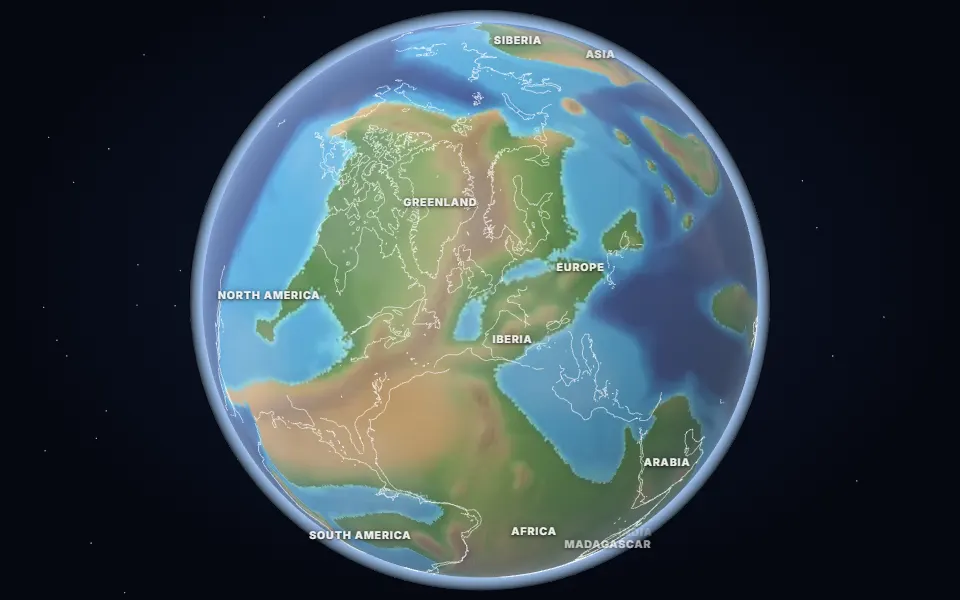 Spin it in 3D and move through time
Map: Ancient maps: PALEOMAP PaleoDEMs (Scotese & Wright 2018), CC BY 4.0 · Natural Earth.
Early in the Carboniferous Period, after the Late Devonian mass extinctions, four-legged animals were living on land and in swamps. Warm, shallow seas laid down the thick limestones found today across Europe and North America.
Forests of tree-sized club mosses and early seed plants spread across the lowlands. Their buried remains would later become coal.
Gondwana was closing on Laurussia. Their collision over the next 50 million years raised the Central Pangean Mountains and assembled the supercontinent Pangea.
Events of the time
Gilboa fossil forest
385 million years ago · New York, USA
Stumps of some of the earliest known trees, about 8 m tall, which had fronds instead of leaves.
Which land was under the sea 350 million years ago?
On the map nearest this age (355 million years ago, Early Mississippian), about 39% of today’s land was under the sea at some point, some 56.5 million km². That makes it number 15 of the 80 maps from 535 to 5 million years ago, which run from 2% to 50%. Each map shows the greatest flooding of its stage, so no single moment had quite this much sea.
- Kaskaskia Sea
Devonian to Mississippian (approximate) · Much of the United States and southern Canada
The third flood over North America’s interior, named after the Kaskaskia sequence of rock layers. Its warm, shallow water built reefs of coral and left the limestones of Indiana and Kentucky.
Was it under the sea? 22 of 42 cities
| Place today | 355 million years ago |
|---|---|
| Bangkok, Thailand | Shallow sea |
| Berlin, Germany | Shallow sea |
| Bismarck, United States | Shallow sea |
| Cairo, Egypt | Shallow sea |
| Calgary, Canada | Shallow sea |
| Casper, Wyoming, United States | Shallow sea |
| Chicago, United States | Shallow sea |
| Dallas, United States | Shallow sea |
| Denver, United States | Shallow sea |
| Hannover, Germany | Shallow sea |
| Kansas City, United States | Shallow sea |
| London, United Kingdom | Shallow sea |
| Mexico City, Mexico | Shallow sea |
| Moscow, Russia | Shallow sea |
| Novosibirsk, Russia | Shallow sea |
| Paris, France | Shallow sea |
| Regina, Canada | Shallow sea |
| Rome, Italy | Shallow sea |
| Salt Lake City, United States | Shallow sea |
| Tehran, Iran | Shallow sea |
| Vienna, Austria | Shallow sea |
| Winnipeg, Canada | Shallow sea |
| Alice Springs, Australia | Land |
| Almaty, Kazakhstan | Land |
| Baku, Azerbaijan | Not modelled |
| Beijing, China | Land |
| Budapest, Hungary | Not modelled |
| Delhi, India | Land |
| Hays, Kansas, United States | Land |
| Johannesburg, South Africa | Land |
| Kathmandu, Nepal | Land |
| Madrid, Spain | Land |
| Montgomery, Alabama, United States | Land |
| Nairobi, Kenya | Land |
| New York, United States | Land |
| Niamey, Niger | Land |
| Perth, Australia | Land |
| Richmond, Queensland, Australia | Land |
| Riyadh, Saudi Arabia | Land |
| São Paulo, Brazil | Land |
| Timbuktu, Mali | Land |
| Warsaw, Poland | Land |
853 marine fossil sites in the Paleobiology Database are dated closely enough to this map. Of those on today’s land, 95% fall in its shaded sea.
Seas: Ancient seas: PaleoCoastlines v7 (Kocsis & Scotese 2021), CC BY 4.0 · Fossils: Paleobiology Database.
Part of the Paleozoic Era & The Cambrian Explosion.