K2
Mountain · 8,611 m
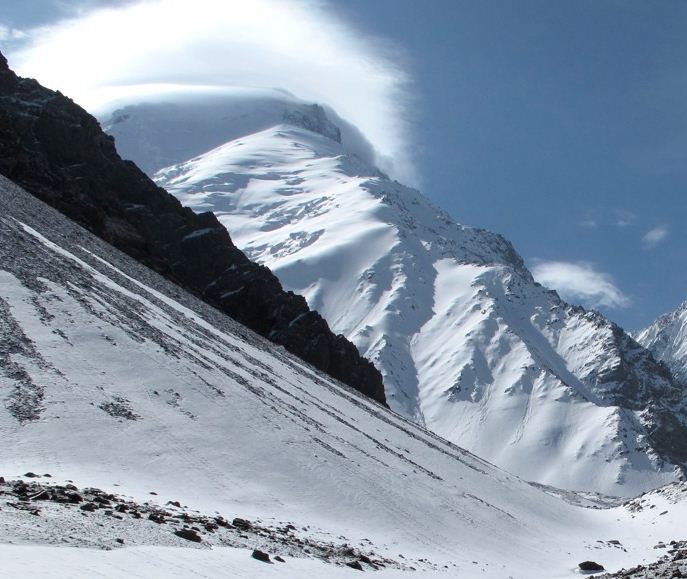
K2 is a mountain rising to 8,611 metres (28,251 ft) in Pakistan, in the Asia region.
K2, also known as Mount Godwin-Austen, at 8,611 metres (28,251 ft) above sea level, is the second-highest mountain on Earth, after Mount Everest at 8,849 metres (29,032 ft). It lies in the Karakoram range, partially in the Gilgit-Baltistan region of Pakistan-administered Kashmir and partially in the China-administered Trans-Karakoram Tract in the Taxkorgan Tajik Autonomous County of Xinjiang.
K2 became known as the Savage Mountain after George Bell—a climber on the 1953 American expedition—said, "It's a savage mountain that tries to kill you." Of the five highest mountains in the world, K2 has long been the deadliest: prior to 2021, approximately one person had died on the mountain for every four who reached the summit. After an increase in successful attempts, as of August 2023, an estimated 800 people have summited K2, with 96 deaths during attempted climbs.
K2 is nicknamed "The King of Mountains" and "The Mountaineers' Mountain", as well as "The Mountain of Mountains", a phrase popularised by Italian climber Reinhold Messner in his book on K2. Although the summit of Everest is at a higher altitude, K2 is a more difficult and dangerous climb.
Adapted from Wikipedia: K2 (CC BY-SA 4.0).
- Elevation
- 8,611 m (28,251 ft)
- Global rank
- #2 of 641 indexed
- Region
- Asia (#2)
- Country
- Pakistan
- Coordinates
- 35.8824°, 76.5132°
Of the 641 named summits indexed in YearMaps, K2 ranks #2 by elevation, below Mount Everest (8,848 m) and above Kanchenjunga (8,586 m).
- Ranges:
- Himalayas (Asia), Salt Range (Asia)
- Neighbouring summits:
- Nanga Parbat (8,125 m), Kangju Kangri (6,725 m), Liushi Shan (7,167 m)
More about K2
Geology
The mountains of K2 and Broad Peak, and the area westward to the lower reaches of Sarpo Laggo glacier, consist of metamorphic rocks, known as the K2 Gneiss and part of the Karakoram Metamorphic Complex. The K2 Gneiss consists of a mixture of orthogneiss and biotite-rich paragneiss. On the south and southeast face of K2, the orthogneiss consists of a mixture of a strongly foliated plagioclase-hornblende gneiss and a biotite-hornblende-K-feldspar orthogneiss, which has been intruded by garnet-mica leucogranitic dikes. In places, the paragneisses include clinopyroxene-hornblende-bearing psammites, garnet (grossular)-diopside marbles, and biotite-graphite phyllites.
Climbing history
The mountain was first surveyed by a British team in 1856. Team member Thomas Montgomerie designated the mountain "K2" for being the second peak of the Karakoram range. The other peaks were originally named K1, K3, K4, and K5, but were eventually renamed Masherbrum, Gasherbrum IV, Gasherbrum II, and Gasherbrum I, respectively. In 1892, Martin Conway led a British expedition that reached "Concordia" on the Baltoro Glacier.
The first serious attempt to climb K2 was undertaken in 1902 by Oscar Eckenstein, Aleister Crowley, Jules Jacot-Guillarmod, Heinrich Pfannl, Victor Wessely, and Guy Knowles via the Northeast Ridge. In the early 1900s, modern transportation did not exist in the region: it took "fourteen days just to reach the foot of the mountain".
Sections adapted from Wikipedia: K2 (CC BY-SA 4.0).
K2: Key Facts
| Topographic prominence | 4,020 m |
|---|---|
| Mountain range | Baltoro Muztagh |
Facts from Wikidata Q43512 (CC0).