
UNESCO World Heritage Sites in Costa Rica
Costa Rica has 4 sites on the UNESCO World Heritage List (1 cultural and 3 natural), the first inscribed in 1983 (Talamanca Range-La Amistad Reserves). The map below plots every one of them alongside the rest of the List, and each site is written up in full further down the page.
- World Heritage Sites
- 4
- Cultural
- 1
- Natural and Mixed
- 3
- First Inscribed
- 1983
Map of World Heritage Sites in Costa Rica
CulturalNaturalMixedIn DangerLarge dots are in Costa Rica. Click a dot to read about the site.

Talamanca Range-La Amistad Reserves
Costa Rica, Panama · 9.4069° N, 82.9386° W · 5,700 km² · 67 km from Puerto Limon
The location of this unique site in Central America, where Quaternary glaciers have left their mark, has allowed the fauna and flora of North and South America to interbreed. Tropical rainforests cover most of the area. Four different Indian tribes inhabit this property, which benefits from close co-operation between Costa Rica and Panama.
Description from the UNESCO World Heritage Centre (CC BY-SA IGO 3.0).
Why Talamanca Range-La Amistad Reserves Is Listed
- (vii)
- Superlative natural phenomena or exceptional natural beauty.
- (viii)
- An outstanding example of major stages of the Earth's history.
- (ix)
- An outstanding example of ongoing ecological and biological processes.
- (x)
- The most important natural habitats for conserving biodiversity.
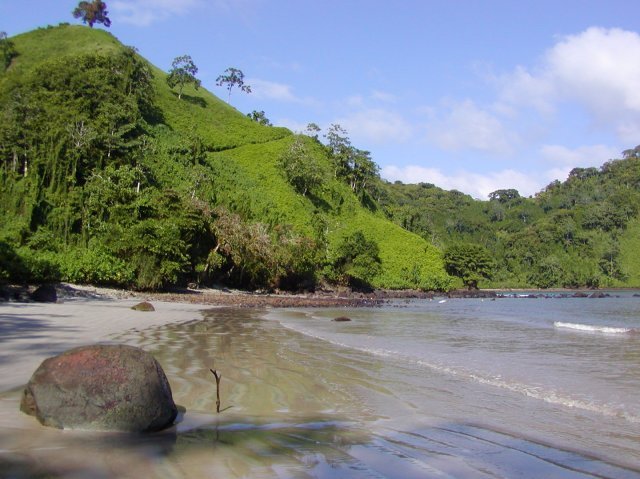
Cocos Island National Park
Costa Rica · 5.5333° N, 87.0667° W · 1,997 km²
Cocos Island National Park, located 550 km off the Pacific coast of Costa Rica, is the only island in the tropical eastern Pacific with a tropical rainforest. Its position as the first point of contact with the northern equatorial counter-current, and the myriad interactions between the island and the surrounding marine ecosystem, make the area an ideal laboratory for the study of biological processes. The underwater world of the national park has become famous due to the attraction it holds for divers, who rate it as one of the best places in the world to view large pelagic species such as sharks, rays, tuna and dolphins.
Description from the UNESCO World Heritage Centre (CC BY-SA IGO 3.0).
Why Cocos Island National Park Is Listed
- (ix)
- An outstanding example of ongoing ecological and biological processes.
- (x)
- The most important natural habitats for conserving biodiversity.

Area de Conservación Guanacaste World Heritage Site
Costa Rica · 10.8500° N, 85.6167° W · 1,470 km² · 31 km from Liberia
The Area de Conservación Guanacaste is a network of protected areas and a World Heritage Site in Guanacaste Province, in northwestern Costa Rica. The World Heritage Site contains an unbroken tract of tropical dry forest and important habitat for several vulnerable species, including the Central American tapir, mangrove hummingbird, and the great green macaw. Over 7,000 plant species and 900 vertebrate species have been located in the park.
Adapted from Wikipedia: Area de Conservación Guanacaste World Heritage Site (CC BY-SA 4.0).
Why Area de Conservación Guanacaste World Heritage Site Is Listed
- (ix)
- An outstanding example of ongoing ecological and biological processes.
- (x)
- The most important natural habitats for conserving biodiversity.
More about Area de Conservación Guanacaste World Heritage Site
UNESCO's Description
The Area de Conservación Guanacaste (inscribed in 1999), was extended with the addition of a 15,000 ha private property, St Elena. It contains important natural habitats for the conservation of biological diversity, including the best dry forest habitats from Central America to northern Mexico and key habitats for endangered or rare plant and animal species. The site demonstrates significant ecological processes in both its terrestrial and marine-coastal environments.
From the UNESCO World Heritage Centre (CC BY-SA IGO 3.0).
Geography
The area of the national parks combined totals 1,470 square kilometers (570 sq mi) as of 2004. This reflects a long-term process of growth, which started with the establishment of Santa Rosa National Park in 1971. Over several decades, surrounding lands were purchased and nearby national parks connected to the growing protected area, so that the Guanacaste Conservation Area came to encompass a high diversity of tropical dry forest, rainforest, cloud forest, and marine habitats. The park contains about two-thirds of the endangered animals of Costa Rica.
It formally became part of National System of Conservation Areas—SINAC in 1994, and a World Heritage Site in 1999. In 2004, the World Heritage Site was extended with a private property measuring 15,000 ha in the Santa Elena rain forest.
Sections adapted from Wikipedia: Area de Conservación Guanacaste World Heritage Site (CC BY-SA 4.0).
Key Facts
| Area | 1,470 km² |
|---|
Facts from Wikidata Q775154 (CC0).
Precolumbian Chiefdom Settlements with Stone Spheres of the Diquís
Costa Rica · 8.9384° N, 83.5025° W · 101 km from Puerto Armuelles
The property includes four archaeological sites located in the Diquís Delta in southern Costa Rica, which are considered unique examples of the complex social, economic and political systems of the period AD 500–1500. They contain artificial mounds, paved areas, burial sites and, most significantly, a collection of stone spheres, between 0.7 m and 2.57 m in diameter, whose meaning, use and production remain largely a mystery. The spheres are distinctive for their perfection, number, size and density, and placement in original locations. Their preservation from the looting that befell the vast majority of archaeological sites in Costa Rica has been attributed to the thick layers of sediment that kept them buried for centuries.
Description from the UNESCO World Heritage Centre (CC BY-SA IGO 3.0).
Why Precolumbian Chiefdom Settlements with Stone Spheres of the Diquís Is Listed
- (iii)
- A unique testimony to a cultural tradition or civilisation.
World Heritage in Costa Rica: Quick Answers
- How many UNESCO World Heritage Sites are in Costa Rica?
- Costa Rica has 4 World Heritage Sites: 1 cultural and 3 natural.
- What was the first World Heritage Site in Costa Rica?
- Talamanca Range-La Amistad Reserves, inscribed in 1983. The most recent is Precolumbian Chiefdom Settlements with Stone Spheres of the Diquís, inscribed in 2014.
- What are the natural World Heritage Sites in Costa Rica?
- Talamanca Range-La Amistad Reserves, Cocos Island National Park, Area de Conservación Guanacaste World Heritage Site.
- Are any World Heritage Sites in Costa Rica in danger?
- None of the World Heritage Sites in Costa Rica is on UNESCO's List of World Heritage in Danger.