
Neoproterozoic Era · Ediacaran Period
Earth 540 Million Years Ago: The Dawn of the Cambrian
What Earth looked like 540 million years ago at the start of the Cambrian: Gondwana in the south, bare land and seas about to fill with animals.
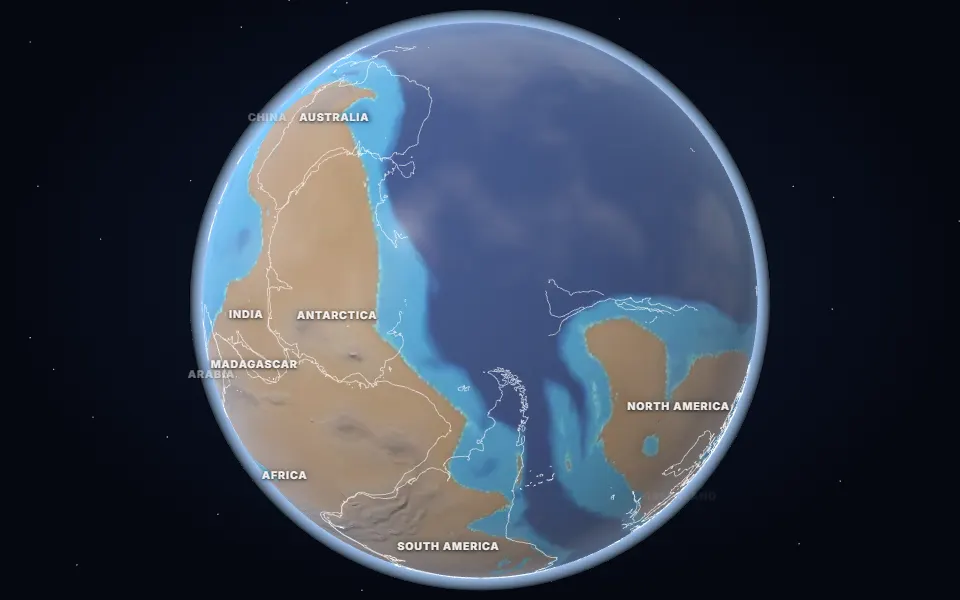 Spin it in 3D and move through time
Map: Ancient maps: PALEOMAP PaleoDEMs (Scotese & Wright 2018), CC BY 4.0 · Natural Earth.
The Cambrian Period began 538.8 million years ago, and with it the Cambrian explosion: within about 20 million years most major groups of animals appear in the fossil record, many with shells, eyes and legs for the first time.
The great southern continent Gondwana, made of today’s South America, Africa, Antarctica, India and Australia, sprawled across the southern hemisphere. North America (Laurentia), Siberia and Baltica were separate continents near the equator.
Land was still bare rock with at most microbial crusts: there were no plants, soil or land animals. Sea levels were rising and flooding the continents with warm, shallow seas. This is the oldest map on the globe drawn from the PALEOMAP elevation models.
Events of the time
Ediacara fossils
555 million years ago · Ediacara Hills, Australia
Imprints of soft-bodied animals such as Dickinsonia, now known to be an animal from the fats preserved in it.
Chengjiang fossils
518 million years ago · Yunnan, China
Soft-bodied animals preserved in fine mud, including some of the earliest relatives of vertebrates: a snapshot of the Cambrian explosion.
Burgess Shale
508 million years ago · British Columbia, Canada
A Cambrian sea floor with strange animals such as five-eyed Opabinia and the predator Anomalocaris, then near the equator.
Which land was under the sea 540 million years ago?
On the map nearest this age (535 million years ago, Early Cambrian), about 33% of today’s land was under the sea at some point, some 47.0 million km². That makes it number 31 of the 80 maps from 535 to 5 million years ago, which run from 2% to 50%. Each map shows the greatest flooding of its stage, so no single moment had quite this much sea.
- Sauk Sea
Cambrian to Early Ordovician (approximate) · The centre of North America: the Great Plains, the Midwest and the Great Lakes
The first great flood over North America’s interior, named after the Sauk sequence of rock layers. Its sandstones and limestones lie under much of the Midwest, and trilobites were its best-known animals.
Was it under the sea? 18 of 42 cities
| Place today | 535 million years ago |
|---|---|
| Bangkok, Thailand | Shallow sea |
| Berlin, Germany | Shallow sea |
| Casper, Wyoming, United States | Shallow sea |
| Denver, United States | Shallow sea |
| Hannover, Germany | Shallow sea |
| Kathmandu, Nepal | Shallow sea |
| Madrid, Spain | Shallow sea |
| Mexico City, Mexico | Shallow sea |
| Moscow, Russia | Shallow sea |
| New York, United States | Shallow sea |
| Novosibirsk, Russia | Shallow sea |
| Paris, France | Shallow sea |
| Richmond, Queensland, Australia | Shallow sea |
| Rome, Italy | Shallow sea |
| Salt Lake City, United States | Shallow sea |
| Tehran, Iran | Shallow sea |
| Vienna, Austria | Shallow sea |
| Warsaw, Poland | Shallow sea |
| Alice Springs, Australia | Land |
| Almaty, Kazakhstan | Not modelled |
| Baku, Azerbaijan | Not modelled |
| Beijing, China | Land |
| Bismarck, United States | Land |
| Budapest, Hungary | Not modelled |
| Cairo, Egypt | Land |
| Calgary, Canada | Land |
| Chicago, United States | Land |
| Dallas, United States | Land |
| Delhi, India | Land |
| Hays, Kansas, United States | Land |
| Johannesburg, South Africa | Land |
| Kansas City, United States | Land |
| London, United Kingdom | Land |
| Montgomery, Alabama, United States | Land |
| Nairobi, Kenya | Land |
| Niamey, Niger | Land |
| Perth, Australia | Land |
| Regina, Canada | Land |
| Riyadh, Saudi Arabia | Land |
| São Paulo, Brazil | Land |
| Timbuktu, Mali | Land |
| Winnipeg, Canada | Land |
197 marine fossil sites in the Paleobiology Database are dated closely enough to this map. Of those on today’s land, 99% fall in its shaded sea.
Seas: Ancient seas: PaleoCoastlines v7 (Kocsis & Scotese 2021), CC BY 4.0 · Fossils: Paleobiology Database.
Part of the Origin of Life & Proterozoic Eon.