
Cenozoic Era · Neogene Period
Earth 5 Million Years Ago: The Pliocene
Earth 5 million years ago: the Mediterranean has just refilled, the Americas are almost joined and early human relatives walk in Africa.
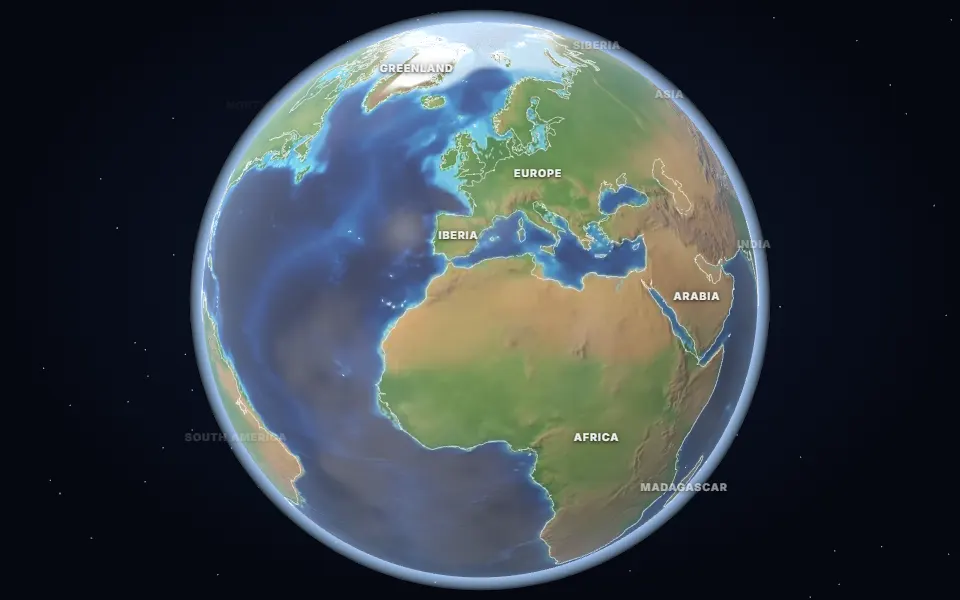 Spin it in 3D and move through time
Map: Ancient maps: PALEOMAP PaleoDEMs (Scotese & Wright 2018), CC BY 4.0 · Natural Earth.
About 5.33 million years ago the Atlantic broke through at Gibraltar and refilled the Mediterranean, which had largely dried out into a salt basin during the Messinian salinity crisis.
The Isthmus of Panama was rising and narrowing the seaway between the Americas; it closed for good about 2.8 million years ago. The climate was warmer than today, and Greenland had little permanent ice.
In Africa, early members of the human family such as Ardipithecus were walking upright, at least part of the time, in woodlands.
Events of the time
The Mediterranean dries out
5.6 million years ago · Strait of Gibraltar
When the Atlantic connection closed, the Mediterranean evaporated and left salt over 1 km thick. About 5.33 million years ago the Atlantic broke back in.
▶ Watch it happen on the globePanama closes
2.8 million years ago · Isthmus of Panama
The land bridge joined North and South America, let animals cross between them and rerouted ocean currents.
Which land was under the sea 5 million years ago?
On the map nearest this age (5 million years ago, Pliocene), about 5% of today’s land was under the sea at some point, some 6.9 million km². That makes it number 75 of the 80 maps from 535 to 5 million years ago, which run from 2% to 50%. Each map shows the greatest flooding of its stage, so no single moment had quite this much sea.
- Paratethys
Oligocene to Pliocene · From Vienna and the Hungarian plain to the Black Sea, the Caspian and the Aral Sea (the Aral Sea itself is a modern lake, now mostly dried)
A great inland sea north of the Alps and the Caucasus, cut off from the Tethys as the mountains rose. The Black, Caspian and Aral seas are what remain of it.
- Pannonian Sea
Late Miocene · The Hungarian plain, with Vienna, Budapest and Belgrade on its edges
A great brackish lake-sea, also called Lake Pannon, left behind when the Paratethys was cut off. It filled the Pannonian Basin until rivers filled it with sediment.
Was it under the sea? 4 of 42 cities
| Place today | 5 million years ago |
|---|---|
| Baku, Azerbaijan | Shallow sea |
| Cairo, Egypt | Shallow sea |
| Perth, Australia | Shallow sea |
| Rome, Italy | Shallow sea |
| Alice Springs, Australia | Land |
| Almaty, Kazakhstan | Land |
| Bangkok, Thailand | Land |
| Beijing, China | Land |
| Berlin, Germany | Land |
| Bismarck, United States | Land |
| Budapest, Hungary | Land |
| Calgary, Canada | Land |
| Casper, Wyoming, United States | Land |
| Chicago, United States | Land |
| Dallas, United States | Land |
| Delhi, India | Land |
| Denver, United States | Land |
| Hannover, Germany | Land |
| Hays, Kansas, United States | Land |
| Johannesburg, South Africa | Land |
| Kansas City, United States | Land |
| Kathmandu, Nepal | Land |
| London, United Kingdom | Land |
| Madrid, Spain | Land |
| Mexico City, Mexico | Land |
| Montgomery, Alabama, United States | Land |
| Moscow, Russia | Land |
| Nairobi, Kenya | Land |
| New York, United States | Land |
| Niamey, Niger | Land |
| Novosibirsk, Russia | Land |
| Paris, France | Land |
| Regina, Canada | Land |
| Richmond, Queensland, Australia | Land |
| Riyadh, Saudi Arabia | Land |
| Salt Lake City, United States | Land |
| São Paulo, Brazil | Land |
| Tehran, Iran | Land |
| Timbuktu, Mali | Land |
| Vienna, Austria | Land |
| Warsaw, Poland | Land |
| Winnipeg, Canada | Land |
2,459 marine fossil sites in the Paleobiology Database are dated closely enough to this map. Of those on today’s land, 80% fall in its shaded sea, one of the weaker fits.
Seas: Ancient seas: PaleoCoastlines v7 (Kocsis & Scotese 2021), CC BY 4.0 · Fossils: Paleobiology Database.
Part of the Cenozoic Era & The Quaternary Ice Ages.